
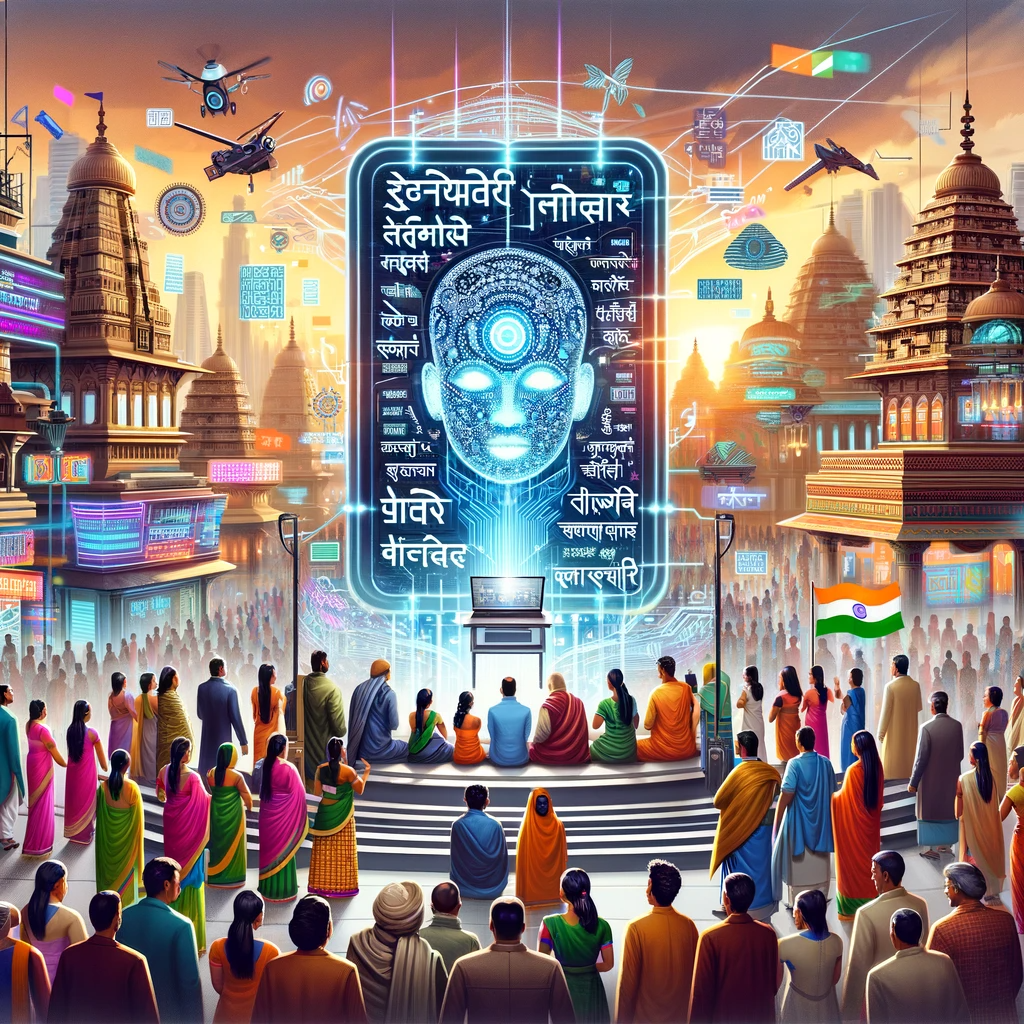
Developing Large Language Models (LLMs) for India’s rich linguistic spectrum faces unique challenges, like diverse languages and dialects, each with its grammar, syntax, cultural context, sensitivity, and local expressions. Additionally, the predominantly oral nature of many Indian languages and the limited electronic documentation complicate data collection, especially for less-spoken languages. Linguistic proficiency and cultural insight knowledge are also challenges.
The scarcity of digital resources, with under 1% of global digital content in India’s diverse languages, poses a significant challenge for LLM training. This is compounded by the varied scripts and frequent code-switching, where speakers blend languages in conversation, requiring advanced processing in LLMs, alongside acknowledged challenges in infrastructure and talent availability.
But, developing LLMs in Indian languages could significantly transform sectors like government, healthcare, and education by improving services and altering job dynamics. This can lead to new roles in data creation and annotation, AI auditing and ethics, and language processing. It reflects a need for field work, incentivizing data owners and professionals in AI, linguistics, creative writing, and to develop and apply AI tools across various sectors and departments. While automation may displace some jobs, AI’s expansion promises new opportunities, ensuring a balanced job market. Education systems are also adapting to equip the future workforce for these evolving demands.
Commercially, LLMs trained in Indian languages can enhance government-citizen interaction, personalize education, and improve healthcare, especially in remote regions. The private sector will see marketing, customer service, and content creation advancements across Indian languages. At the same time, agriculture and finance will benefit from AI-driven insights and simplified communications, promoting financial inclusion.
India’s initial focus should be leveraging open-source models with platforms like Bhashini for practical application to enrich these models with Indian contexts and languages. Also, digitizing India’s rich traditional knowledge and customizing technologies like speech recognition and Romanized keyboards for local languages are vital to making LLMs more user-friendly for Indians, setting the stage for developing native models eventually.
The government is also developing an AI mission to address infrastructure challenges. Additionally, Bhasha Daan, a critical Indian crowdsourcing initiative, empowers citizens to bridge the digital language divide by donating their language skills in voice, translation, and data validation, crucially enhancing the development of LLMs in Indian languages.
LLMs in Indian languages can act as a bridge towards a more inclusive society, breaking down language barriers and fostering growth that resonates across India, democratizing the technology for empowered India.
You can check my LinkedIn post as well
 Welcome! I’m amitkumar Shrivastava, Head of AI, Global Fujitsu Distinguished Engineer, and Fujitsu Fellow. This blog is dedicated to exploring the latest in technology, with a focus on artificial intelligence. Here, I share insights from my work, tech travels, and ongoing projects in the AI space. Join me as we dive into cutting-edge innovations and industry updates. Know about me more on : LinkedIn: https://www.linkedin.com/in/amitkumar-shrivastava/ and Company Public Profile (Distinguished Engineer): https://global.fujitsu/en-global/about/activities/global-fde/amitkumar-shrivastava
Leave a comment