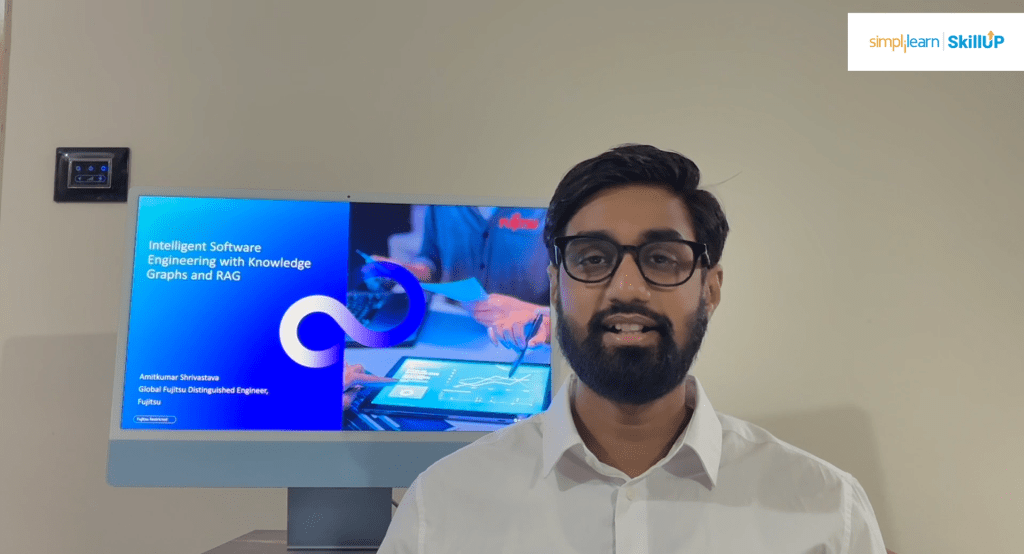
In an era where software complexity continues to surge, traditional development and maintenance practices are struggling to keep pace. Fragmented documentation, disjointed systems, and siloed knowledge often hinder progress, leading to inefficiencies and risks across the software lifecycle. To address these, I have developed one short 1 hour course where you can understand merging the power of Knowledge Graphs (KG) with Retrieval-Augmented Generation (RAG) in Software Engineering.
This course briefly introduces KG and RAG and also explores how Fujitsu’s KG-Extended RAG framework is redefining software engineering. From scaling reasoning to enabling explainability, supporting multi-role outputs, and laying the foundation for autonomous development workflows, this architecture marks a pivotal shift toward smarter, more context-aware engineering systems.
You can access the course here free of cost on Simplilearn platform –
https://www.simplilearn.com/knowledge-graphs-and-rag-free-course-skillup

moment to explore how KG-Extended RAG can elevate your workflows, reduce risk, and unlock smarter outcomes.
About the Course
Course Objective:
- Understand the core concepts of Knowledge Graphs and Retrieval-Augmented Generation (RAG)
- Recognize how these technologies address real-world software engineering challenges
- Explore practical use cases where KG and RAG enhance code understanding, documentation, and developer productivity
- Learn how Fujitsu’s Knowledge Graph Enhanced RAG solution applies these technologies in enterprise-grade development workflows, and get introduced to Kozuchi (https://portal.research.global.fujitsu.com/kozuchi/)
- Gain clarity on how to adopt or explore these approaches in their own engineering contexts.
Target Audience & Learner Persona:
A short AI course that introduces Knowledge Graphs and Retrieval-Augmented Generation for software engineering, focusing on real use cases rather than code-level implementation:
- Anyone familiar with AI interested in applied use cases without coding requirements
- Software engineers exploring how AI can improve coding, documentation, and knowledge reuse
- Technical Leads and Architects seeking structured knowledge modeling and smart retrieval systems
- Data scientists collaborating with engineering teams and integrating with development workflows
- Engineering managers assessing AI-driven tools to enhance team productivity and decision-making.
Learner Outcomes:
Module 1: Introduction & Challenges in Software Engineering
- Understand the key challenges in modern software engineering
- Recognize why AI-driven approaches like Knowledge Graphs and RAG are becoming essential
- Know what to expect from this course and how it is structured.
Module 2: Knowledge Graphs
- Explain what a Knowledge Graph is and how it works
- Identify how Knowledge Graphs help manage complex software systems
- Explore real-world use cases of KGs in development workflows.
Module 3: Retrieval-Augmented Generation (RAG)
- Describe how RAG works using retrieval, augmentation, and generation
- Understand how RAG improves software development tasks like code search and documentation
- Identify the key components of a RAG-based system.
Module 4: Fujitsu’s KG-Enhanced RAG for Software Engineering
- Learn how Fujitsu combines Knowledge Graphs, RAG, and program analysis to extract and structure information from code, logs, and documents
- Understand how this approach enables accurate, business-level design generation while minimizing LLM hallucinations
- Watch a demo showing how the solution integrates into real software engineering workflows using flow analysis, call relationships, and Chain of Thought prompting
- Get introduced to Fujitsu AI Platform (Kozuchi).
Module 5: Summary & What’s Next
- Summarize the core ideas behind Knowledge Graphs and RAG
- Few more KG+RAG applications
 Welcome! I’m amitkumar Shrivastava, Head of AI, Global Fujitsu Distinguished Engineer, and Fujitsu Fellow. This blog is dedicated to exploring the latest in technology, with a focus on artificial intelligence. Here, I share insights from my work, tech travels, and ongoing projects in the AI space. Join me as we dive into cutting-edge innovations and industry updates. Know about me more on : LinkedIn: https://www.linkedin.com/in/amitkumar-shrivastava/ and Company Public Profile (Distinguished Engineer): https://global.fujitsu/en-global/about/activities/global-fde/amitkumar-shrivastava
Leave a comment